Exponents
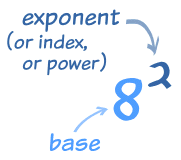
The exponent of a number says how many times to use the number in a multiplication.
In 82 the "2" says to use 8 twice in a multiplication,
so 82 = 8 × 8 = 64
so 82 = 8 × 8 = 64
In words: 82 could be called "8 to the power 2" or "8 to the second power", or simply "8 squared"
Exponents are also called Powers or Indices.
Some more examples:
Exponents make it easier to write and use many multiplications
You can multiply any number by itself as many times as you want using exponents.
Try here:
34 = 3 × 3 × 3 × 3 = 81
© 2015 MathsIsFun.com v 0.8
In General
So in general:
| an tells you to multiply a by itself, so there are n of those a's: | 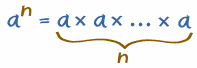 |
Other Way of Writing It
Sometimes people use the ^ symbol (above the 6 on your keyboard), as it is easy to type.
Negative Exponents
Negative? What could be the opposite of multiplying?
Dividing!
A negative exponent means how many times to divide one by the number.
You can have many divides:
But that can be done an easier way:
In General
 |
That last example showed an easier way to handle negative exponents:
|
More Examples:
| Negative Exponent | Reciprocal of Positive Exponent | Answer | ||
|---|---|---|---|---|
| 4-2 | = | 1 / 42 | = | 1/16 = 0.0625 |
| 10-3 | = | 1 / 103 | = | 1/1,000 = 0.001 |
| (-2)-3 | = | 1 / (-2)3 | = | 1/(-8) = -0.125 |
What if the Exponent is 1, or 0?
| 1 | If the exponent is 1, then you just have the number itself (example 91 = 9) | |
| 0 | If the exponent is 0, then you get 1 (example 90 = 1) | |
| But what about 00 ? It could be either 1 or 0, and so people say it is "indeterminate". |
It All Makes Sense
My favorite method is to start with "1" and then multiply or divide as many times as the exponent says, then you will get the right answer, for example:
| Example: Powers of 5 | |||
|---|---|---|---|
| .. etc.. | 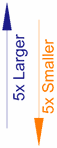 | ||
| 52 | 1 × 5 × 5 | 25 | |
| 51 | 1 × 5 | 5 | |
| 50 | 1 | 1 | |
| 5-1 | 1 ÷ 5 | 0.2 | |
| 5-2 | 1 ÷ 5 ÷ 5 | 0.04 | |
| .. etc.. | |||
If you look at that table, you will see that positive, zero or negative exponents are really part of the same (fairly simple) pattern.
Be Careful About Grouping
To avoid confusion, use parentheses () in cases like this:
| With () : | (-2)2 = (-2) × (-2) = 4 |
| Without () : | -22 = -(22) = - (2 × 2) = -4 |
| With () : | (ab)2 = ab × ab |
| Without () : | ab2 = a × (b)2 = a × b × b |


0 comments:
Post a Comment