Algebra - Substitution
"Substitute" means to put in the place of another.
Substitution
In Algebra "Substitution" means putting numbers where the letters are:
 | When we have: |
| |||||
| And we know that x=6 ... | ||||||
| ... then we can "substitute" 6 for x: |
|
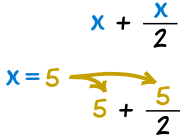
As that last example showed, we may not always get a number for an answer, sometimes just a simpler formula.
Negative Numbers
When substituting negative numbers, put () around them so you get the calculations right.
In that last example:
- the − (−2) became +2
- the (−2)2 became +4
because of these special rules:
| Rule | Adding or Subtracting | Multiplying or Dividing | ||
|---|---|---|---|---|
 | Two like signs become a positive sign | 3+(+2) = 3 + 2 = 5 | 3 × 2 = 6 | |
| 6−(−3) = 6 + 3 = 9 | (−3) × (−2) = 6 | |||
 | Two unlike signs become a negative sign | 7+(−2) = 7 − 2 = 5 | 3 × (−2) = −6 | |
| 8−(+2) = 8 − 2 = 6 | (−3) × 2 = −6 |


0 comments:
Post a Comment